Research Articles
1. Wen, Zhendong; Li, Fenglin; Qu, Kairu; Sun, Dayin; Yang, Hua; Zhu, Jintao; Nie, Zhihong*; Lin, Zhiqun*; Yang, Zhenzhong*. Large-Scale Synthesis of Janus Polymer Nanorods via Electrostatics-Mediated Reversible Addition-Fragmentation Chain Transfer Polymerization in Concentrated Solutions. CCS Chem., 2026, 8, 246-260.
Janus polymer nanorods with tunable compositions and microstructures possess directionally specific interactions, enabling their self-assembly into hierarchically structured materials (e.g., biomimetic pillared nanostructures). Traditional synthesis methods usually require highly dilute conditions (<1 mg/mL) to prevent aggregation. Herein, we report the synthesis of Janus polymer nanorods by electrostatics-mediated reversible addition-fragmentation chain transfer copolymerization of cross-linkers and monomers from polymer bottlebrushes. This method achieves an unprecedentedly high solid content over 100 mg/mL, that is, two orders of magnitude higher than that attainable by conventional approaches. The composition, microstructure (e.g., multilayered architecture), and characteristic dimension of the nanorods are broadly tunable. As a representative example, AB-type Janus nanorods are derived by orthogonal modifications of the end blocks, introducing desired functional groups to drive directional interactions. The Janus nanorods serve as building blocks to self-assemble into diverse superstructures from nanowires to continuous networks, providing a facile platform for the in-situ construction of functional materials within suitable matrices.
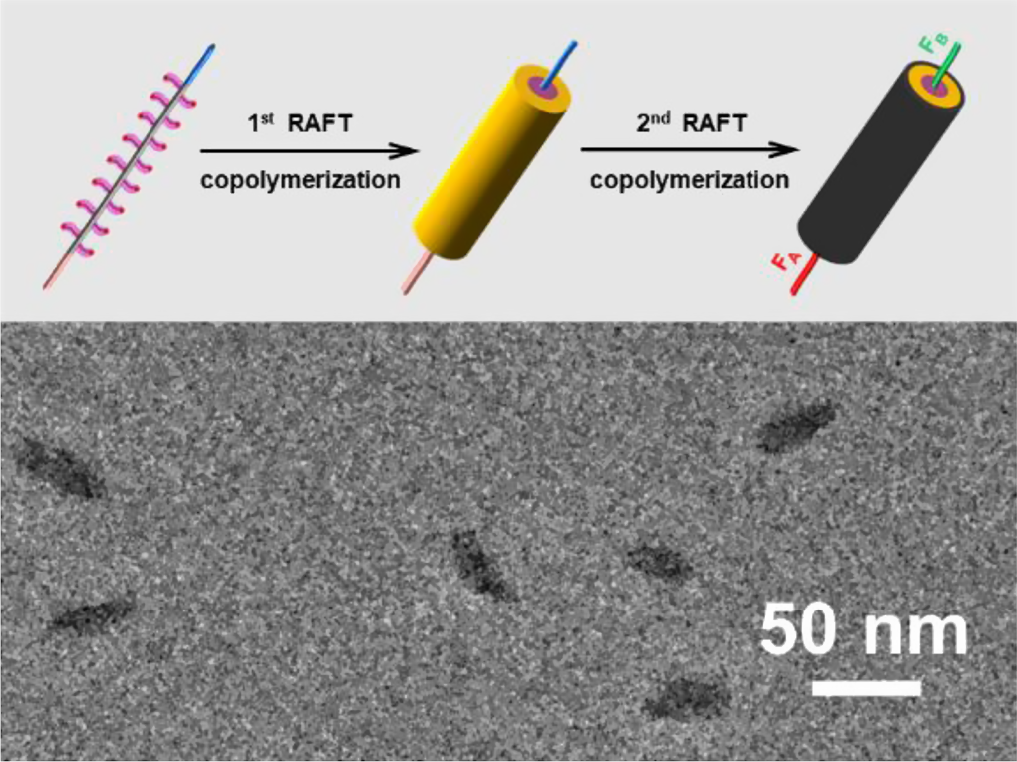
https://doi.org/10.31635/ccschem.025.202506889
2. Wang, Dan; Zhong, Zhixuan; Yang, Zhenzhong*; Jiang, Jian*. Electrostatic Mediation in Synthesis of Single-Chain Nanoparticles in Concentrated Solutions. Macromolecules, 2026, http://doi/10.1021/acs.macromol.5c02798
Rational design and large-scale synthesis of polymer single-chain nanoparticles (SCNPs) via intramolecular cross-linking of polymers in concentrated solutions is of great significance in polymer and nanomaterials science. It is urgently required to develop methods to suppress intermolecular cross-linking in highly concentrated polymer solutions. Yang et al. have recently proposed a novel effective method of electrostatics-mediated intramolecular cross-linking of polymer single-chains in concentrated solutions. Herein, we develop a scaling theory and perform large-scale dissipative particle dynamics simulation to elucidate the key role of electrostatic mediation in the intramolecular cross-linking. Specifically, the effectiveness of electrostatic repulsion, hence electrostatic mediation, is confirmed, which exhibits a nonmonotonic dependence on electrostatic strength. The effectiveness is enhanced to the maximum when the electrostatic strength is increased to the transition boundary between the weak and strong electrostatic coupling regimes. Such nonmonotonic behavior is attributed to the onset of counterion condensation to suppress the formation of SCNPs under strong electrostatic coupling conditions. The current finding helps to further understand the electrostatic mediation and guides the design and large-scale synthesis of SCNPs in concentrated solutions.
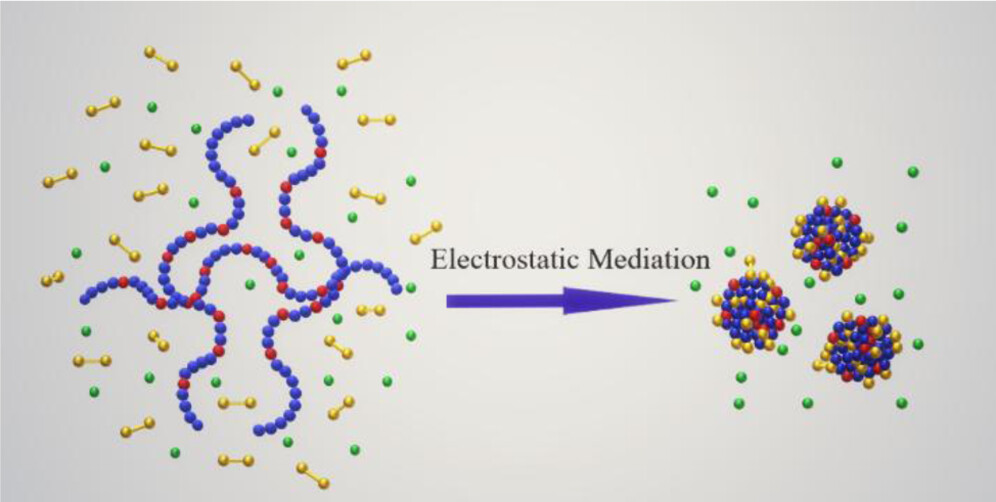
http://doi/10.1021/acs.macromol.5c02798
3. Wang, Dan; Yang, Zhenzhong*; Jiang, Jian*. Cross-linking driven collapse dynamics of polyelectrolyte single-chain in good solvents. J. Chem. Phys., 2026, 164, 094908.
Electrostatics-mediated intramolecular cross-linking is proven effective for large-scale synthesis of single-chain nanoparticles (SCNPs) from polyelectrolyte chains in concentrated solutions. However, the underlying mechanism of cross-linking-driven collapse dynamics remains insufficiently explored. Here, we perform coarse-grained dissipative particle dynamics simulations to unveil the cross-linking-driven collapse dynamics of polyelectrolyte single-chain, which is dependent on chain length and electrostatic strength. It is shown that the timescale of the cross-linking-driven collapse follows a power-law dependence on chain length with a negative scaling exponent, which is fundamentally different from the solvent-induced collapse dynamics. We further explain this distinction by developing a Model A-type dynamics theory. A non-monotonic dependence of collapse timescale on electrostatic strength is identified with the power-law scaling exponents being positive and negative in the weak and strong electrostatic coupling regime, respectively. This is understood by the effect of counterion condensation within our dynamics model. The theoretical result helps understand the electrostatics-mediated intramolecular cross-linking-driven collapse of single-chain and precisely control the microstructure of derived SCNPs.
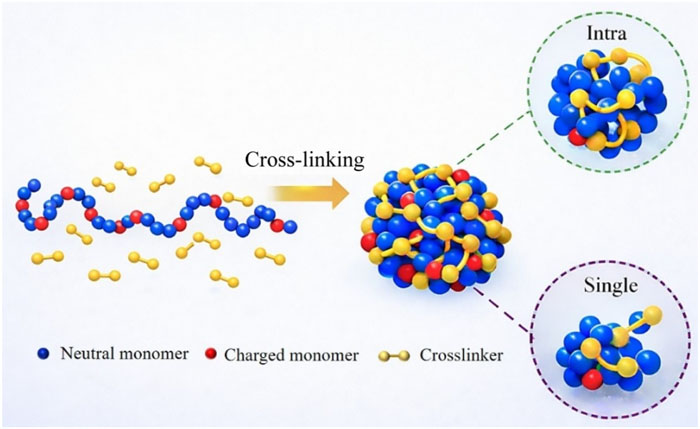
https://doi.org/10.1063/5.0321317
Reviews
1. Qu, Kairu†; Guo, Lyuzhou†; Wang, Wenbin†; Yan, Xuzhou; Cao, Xuezheng; Yang, Zhenzhong*. Recent Progresses in Synthesis of Cyclic Polymers in Large-scale and Some Functionalized Composites. Chem. J. Chinese Universities, 2026, 47(1), 20250212.
Among various architectures of polymers, end-group-free rings have attracted growing interests due to their distinct physicochemical performances over the linear counterparts which are exemplified by reduced hydrodynamic size and slower degradation. It is key to develop facile methods to large-scale synthesis of polymer rings with tunable compositions and microstructures. Recent progresses in large-scale synthesis of polymer rings against single-chain dynamic nanoparticles, and the example applications in synchronous enhancing toughness and strength of polymer nanocomposites are summarized. Once there is the breakthrough in rational design and effective large-scale synthesis of polymer rings and their functional derivatives, a family of cyclic functional hybrids would be available, thus providing a new paradigm in developing polymer science and engineering.
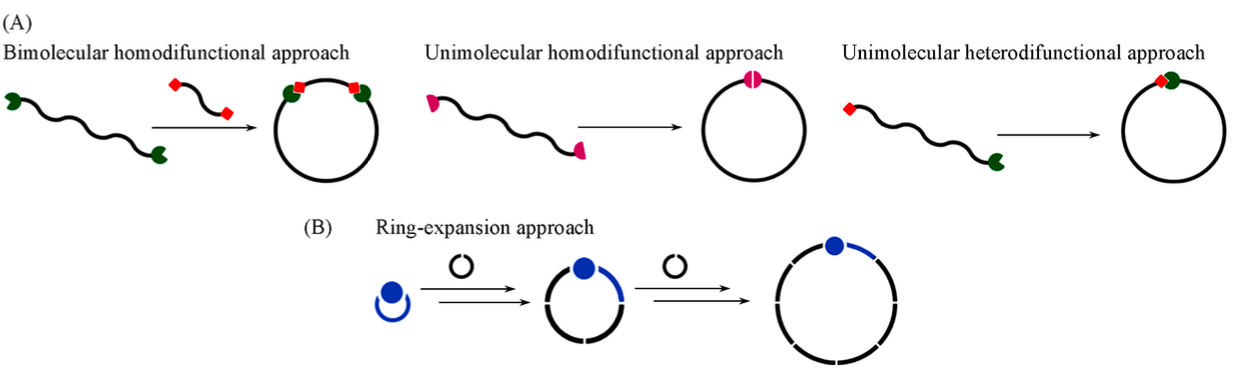
https://doi.org/10.7503/cjcu20250212
