Research Articles
1. Wen, Zhendong; Li, Fenglin; Qu, Kairu; Sun, Dayin; Yang, Hua; Zhu, Jintao; Nie, Zhihong*; Lin, Zhiqun*; Yang, Zhenzhong*. Large-Scale Synthesis of Janus Polymer Nanorods via Electrostatics-Mediated Reversible Addition-Fragmentation Chain Transfer Polymerization in Concentrated Solutions. CCS Chem., 2026, 8, 246-260.
Janus polymer nanorods with tunable compositions and microstructures possess directionally specific interactions, enabling their self-assembly into hierarchically structured materials (e.g., biomimetic pillared nanostructures). Traditional synthesis methods usually require highly dilute conditions (<1 mg/mL) to prevent aggregation. Herein, we report the synthesis of Janus polymer nanorods by electrostatics-mediated reversible addition-fragmentation chain transfer copolymerization of cross-linkers and monomers from polymer bottlebrushes. This method achieves an unprecedentedly high solid content over 100 mg/mL, that is, two orders of magnitude higher than that attainable by conventional approaches. The composition, microstructure (e.g., multilayered architecture), and characteristic dimension of the nanorods are broadly tunable. As a representative example, AB-type Janus nanorods are derived by orthogonal modifications of the end blocks, introducing desired functional groups to drive directional interactions. The Janus nanorods serve as building blocks to self-assemble into diverse superstructures from nanowires to continuous networks, providing a facile platform for the in-situ construction of functional materials within suitable matrices.
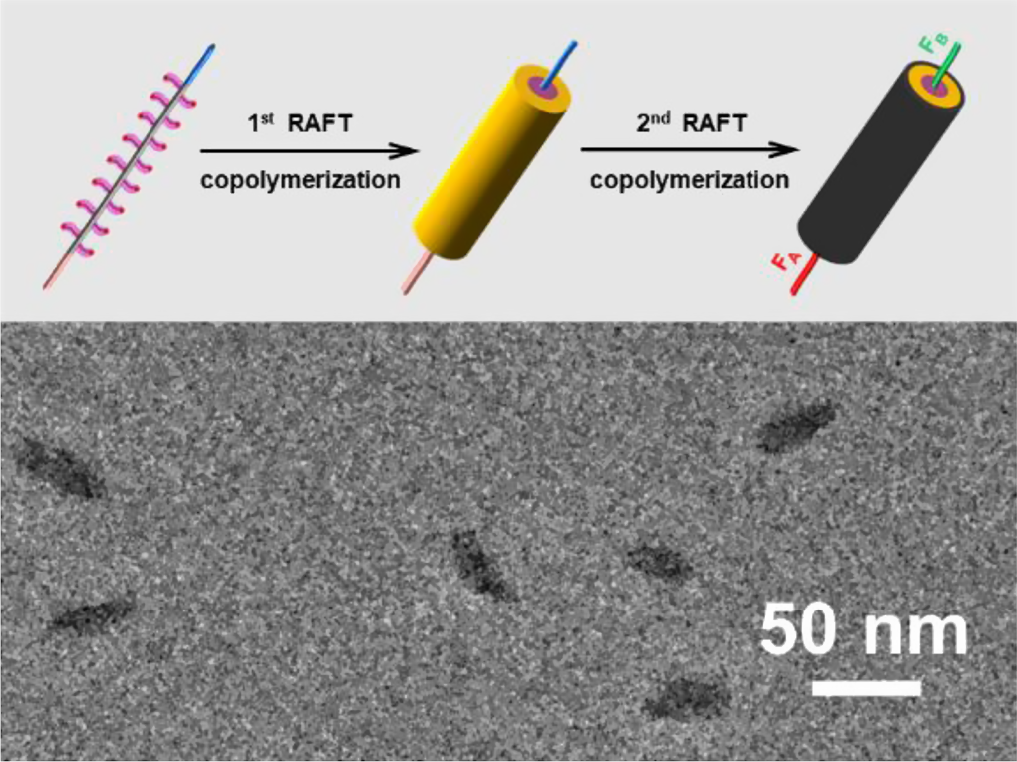
https://doi.org/10.31635/ccschem.025.202506889
2. Wang, Dan; Zhong, Zhixuan; Yang, Zhenzhong*; Jiang, Jian*. Electrostatic Mediation in Synthesis of Single-Chain Nanoparticles in Concentrated Solutions. Macromolecules, 2026, 59, 642-652.
Rational design and large-scale synthesis of polymer single-chain nanoparticles (SCNPs) via intramolecular cross-linking of polymers in concentrated solutions is of great significance in polymer and nanomaterials science. It is urgently required to develop methods to suppress intermolecular cross-linking in highly concentrated polymer solutions. Yang et al. have recently proposed a novel effective method of electrostatics-mediated intramolecular cross-linking of polymer single-chains in concentrated solutions. Herein, we develop a scaling theory and perform large-scale dissipative particle dynamics simulation to elucidate the key role of electrostatic mediation in the intramolecular cross-linking. Specifically, the effectiveness of electrostatic repulsion, hence electrostatic mediation, is confirmed, which exhibits a nonmonotonic dependence on electrostatic strength. The effectiveness is enhanced to the maximum when the electrostatic strength is increased to the transition boundary between the weak and strong electrostatic coupling regimes. Such nonmonotonic behavior is attributed to the onset of counterion condensation to suppress the formation of SCNPs under strong electrostatic coupling conditions. The current finding helps to further understand the electrostatic mediation and guides the design and large-scale synthesis of SCNPs in concentrated solutions.
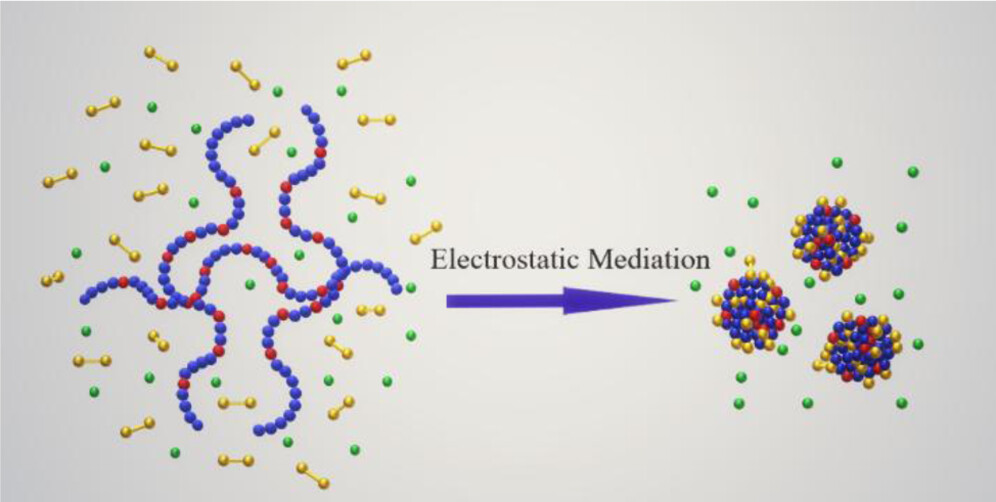
http://doi.org/10.1021/acs.macromol.5c02798
3. Wang, Dan; Yang, Zhenzhong*; Jiang, Jian*. Cross-linking driven collapse dynamics of polyelectrolyte single-chain in good solvents. J. Chem. Phys., 2026, 164, 094908.
Electrostatics-mediated intramolecular cross-linking is proven effective for large-scale synthesis of single-chain nanoparticles (SCNPs) from polyelectrolyte chains in concentrated solutions. However, the underlying mechanism of cross-linking-driven collapse dynamics remains insufficiently explored. Here, we perform coarse-grained dissipative particle dynamics simulations to unveil the cross-linking-driven collapse dynamics of polyelectrolyte single-chain, which is dependent on chain length and electrostatic strength. It is shown that the timescale of the cross-linking-driven collapse follows a power-law dependence on chain length with a negative scaling exponent, which is fundamentally different from the solvent-induced collapse dynamics. We further explain this distinction by developing a Model A-type dynamics theory. A non-monotonic dependence of collapse timescale on electrostatic strength is identified with the power-law scaling exponents being positive and negative in the weak and strong electrostatic coupling regime, respectively. This is understood by the effect of counterion condensation within our dynamics model. The theoretical result helps understand the electrostatics-mediated intramolecular cross-linking-driven collapse of single-chain and precisely control the microstructure of derived SCNPs.
https://doi.org/10.1063/5.0321317
4. Qiu, Shaoen; Liu, Jiachao; Li, Moyuan; Lu, Tianyu; Yang, Zhenzhong*; Chen, Daoyong*; Nie, Zhihong*. Deswelling Behavior of Polymer Single-Chain Nanoparticles in Concentrated Solutions and the Resulting Internal Dynamic Heterogeneity. Macromolecules, 2026, 59, 7352-7366.
Polymer single-chain nanoparticles (SCNPs) represent a unique class of soft nano-objects, yet their internal dynamics under crowding remain poorly understood. Here, we show that when the polystyrene-based SCNP solutions exceed the critical overlapping concentration (c*SCNP), nonuniform deswelling of the SCNPs generates spatially heterogeneous microenvironments, which in turn give rise to two distinct dynamic modes. Intrachain cross-linked polystyrene SCNPs (7% cross-linking degree) were synthesized on the gram scale via an in situ cationic polymerization strategy, and their compact, semiflexible topologies were established through comprehensive structural characterization. Multiangle dynamic light scattering (DLS) measurements reveal a transition from a single relaxation process in dilute solutions to dual relaxation behavior in concentrated regimes: a fast mode corresponding to the cooperative diffusion of chain “blobs” driven by concentration fluctuations, and a slow mode associated with the caged, non-Brownian motion of “blobs” confined within increasingly rigid microdomains. Theoretical analysis, comparison between SCNPs and linear chains, and NMR T2 relaxation measurements together confirm that this dynamic heterogeneity originates from deswelling-induced variations in local rigidity within individual SCNPs. These findings provide the first experimental demonstration of heterogeneous diffusion dynamics across multiple time scales in concentrated SCNP solutions, highlighting the pivotal role of topological confinement in governing soft nanoparticle behaviors and offering guidance for the rational design of SCNP-based functional materials.
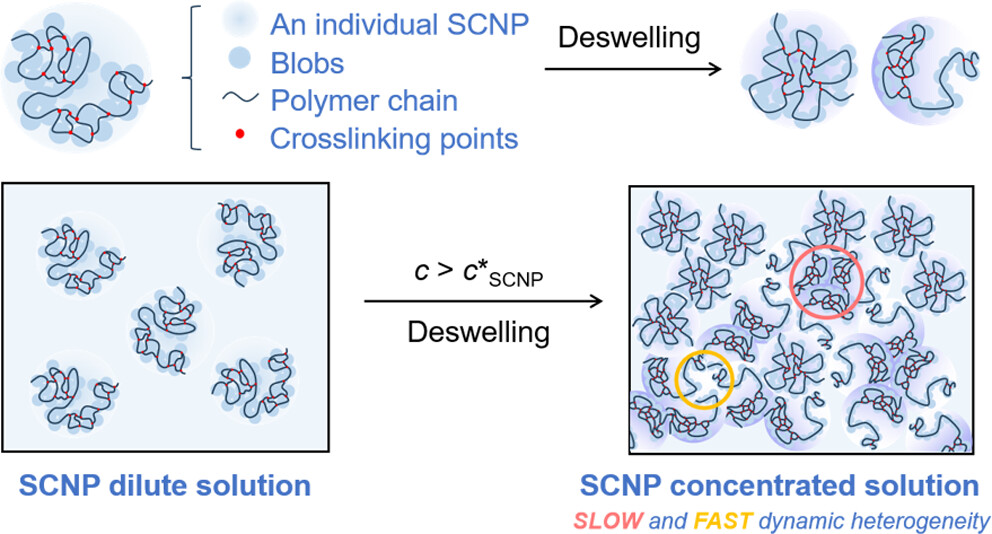
https://doi.org/10.1021/acs.macromol.5c03482
5. Qiu, Shaoen; Li, Moyuan; Liu, Jiachao; Yang, Zhenzhong; Huang, Xiayun*; Nie, Zhihong. Decoding Macromolecular Compactness by Light Scattering: From Measurement to Chemical Insight in the Teching Laboratory. J. Chem. Educ., 2026, https://doi.org/10.1021/acs.jchemed.6c00306
A critical pedagogical challenge in polymer science is bridging the gap between theoretical concepts and their experimental validation. Herein, we present an integrated laboratory course designed to address this challenge by immersing students in a complete model construction-validation cycle. This course centers on experimentally determining the ρ-value (ρ = Rh/Rg), one of the key quantitative descriptors of macromolecular compactness, using light scattering techniques. Using a series of architecturally defined samples, including linear chain and single-chain nanoparticles (SCNPs) with varying cross-linking densities, students performed static and dynamic light scattering (SLS/DLS) to measure their radius of gyration (Rg) and hydrodynamic radius (Rh). Through guided data analysis, including constructing Zimm plots, fitting correlation functions, and evaluating the appropriateness of analytical models, students actively engaged in the iterative process of scientific inquiry-operating instruments, processing raw data, and comparing results to theoretical predictions. This approach transforms the laboratory from a routine characterization exercise into a coherent investigative experience that connects measurement, model-based analysis, and chemical insights of the structure-property relationship.
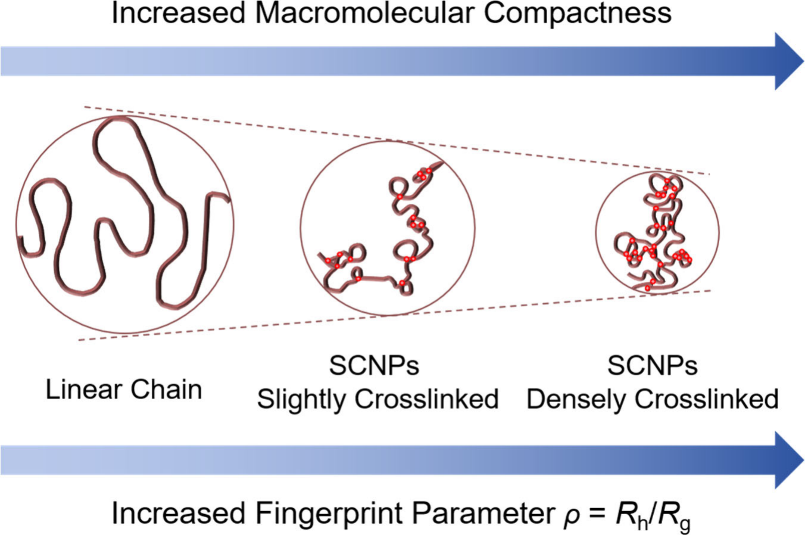
https://doi.org/10.1021/acs.jchemed.6c00306
6. Cui, Shitong†; Tian, Jing†; Zhu, Mengyu†; Liu, Zihan; Cao, Yufei; Liu, Yu; Feng, Yuxiao; Xu, Wanghui; Lai, Weijian; Yang, Hongyl; Xu, Jun*; Guo, Baohua; Qiu, Lin*; Yang, Zhenzhong*; Paolo, Falcaro*; Ge, Jun*. Metal-Organic Framework-Gated Biocatalysis Enables Triggered Depolymerization of Melt-Processed Polyesters. Angew. Chem. Int. Ed., 2026, 65, e4831016.
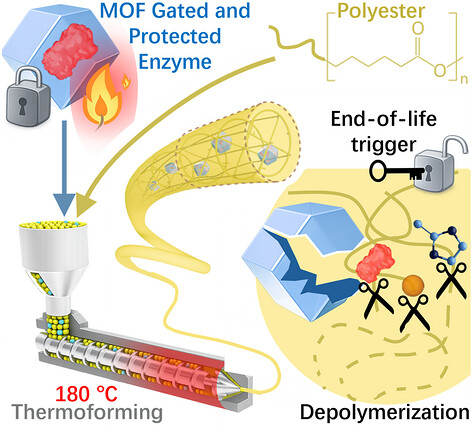
Controlling biocatalytic activity in melt-processed polymers is a central challenge for triggered depolymerization, because enzymes deactivate at melt-extrusion temperatures. Here, metal–organic framework-gated biocatalysis, achieved by encapsulating enzymes within zeolitic imidazolate framework-8 (ZIF-8), preserves > 85% activity after 2 min at 180°C while regulating substrate access. Enzyme@ZIF-8 biocomposite production scales to ∼50 kg day-1 and is compounded by twin-screw extrusion into poly(ε-caprolactone) (PCL), poly(butylene adipate-co-terephthalate) (PBAT), and polylactide (PLA) at a tonne-per-day scale; pellets are compatible with standard thermoforming. The enzyme@ZIF/plastic composites retain mechanical performance comparable to the neat polymers during processing and use. At the end-of-life, chemical triggers dissolve the ZIF-8 gate, releasing the enzyme, Zn2+ and imidazolate to cooperatively accelerate depolymerization. Degradation increases 13.3–62.8-fold for PCL and PLA in water and 1.7-fold under industrial composting for PBAT and enables anaerobic PBAT digestion, whereas pristine polyesters show negligible conversion. This melt-processable platform establishes gated, on-demand depolymerization compatible with industrial polymer manufacturing.
https://doi.org/10.1002/anie.4831016
7. Qu, Kairu†; Wang, Yan†; Yang, Zhenzhong*. Scalable Synthesis of Janus Fluorescent Single-chain Nanoparticles by Electrostatics-mediated Intramolecular Crosslinking. Acta Polymerica Sinica (in Chinese), 2026, 57(9), 2093-2101.
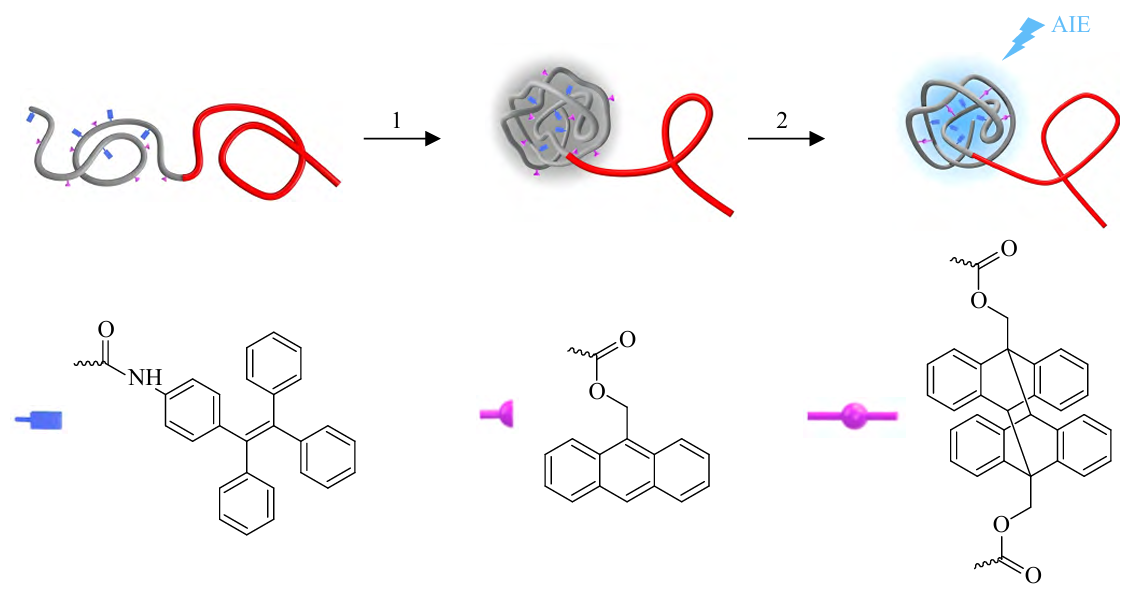
Polymer single-chain nanoparticles (SCNPs) with distinctly compartmentalized physicochemical species are promising in catalysis, nanomedicine, and high-performance materials. In this work, a fluorescent SCNP and the Janus derivative were synthesized via electrostatics-mediated sequential dynamic and covalent intramolecular crosslinking. The dynamic interaction between the carboxylic acid groups of the modifiers and the tertiary amine groups on the polymer chain was employed for the first-step intramolecular crosslinking, enabling synthesis of compact SCNPs in concentrated solutions. These dynamically crosslinked SCNPs were subsequently fixated by covalent bonding through UV-induced coupling of anthracene groups. The compact microstructure was preserved. The rotation of pendant tetraphenylethylene (TPE) units within the SCNP was greatly restricted giving rise to a significantly enhanced aggregation-induced emission (AIE). Similarly, a tadpole-like Janus fluorescent SCNP was derived from the diblock copolymer, providing an effective tool for interfacial fluorescence labeling by forming a well-defined monolayer.
http://doi.org/10.11777/j.issn1000-3304.2026.26124
8. Zhang, Xinyue; Qiu, Shaoen; Zheng, Di; Zhang, Yan; Sang, Yutao; Li, Bing*; Yang, Zhenzhong*; Huang, Xiayun*; Nie, Zhihong*. Surface engineering enables controllable self-assembly of tadpole-like hybrid single-chain nanoparticles. Colloids and Surfaces A: Physicochemical and Engineering Aspects, 2026, 10.1016/j.colsurfa.2026.141837
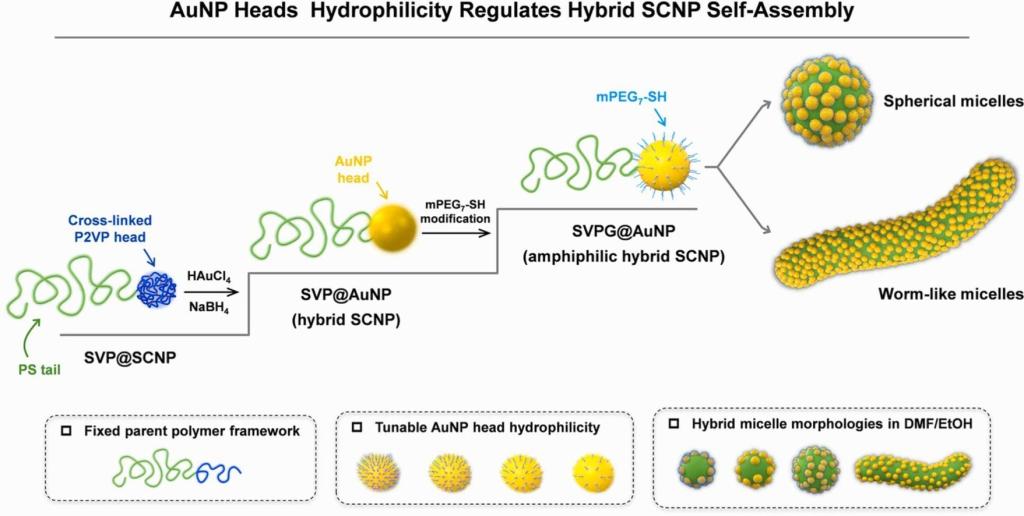
Single-chain nanoparticles (SCNPs) are well-defined nanoscale objects formed by intramolecular collapse of individual polymer chains which represent versatile building blocks for hierarchical self-assembly. Here, a tadpole-like SCNP based on polystyrene-block-poly(2-vinylpyridine) (SVP SCNP) was synthesized via electrostatics-mediated intramolecular crosslinking, and the corresponding hybrid SCNP (SVP@AuNP) was derived after growth of ultrasmall Au nanoparticles (<5 nm) within the crosslinked SCNP. Surface modification of the AuNP with thiol-terminated oligo(ethylene glycol) ligands (mPEG7-SH) generated hybrid nanoparticles (SVPG@AuNPs) with the tunable amphiphilicity. The nanoparticles are composed of hydrophilic AuNP heads and hydrophobic PS tails. Without alteration of the SCNP structure, amphiphilicity of the hybrid SCNPs could be continuously tuned by varying the mPEG7-SH/Au feed ratio. As a result, the self-assembly is controllable from spherical to worm-like micelles in selective solvents. The interplay between AuNP-head hydrophilicity and solvent selectivity on the assembly morphology was elucidated. Dissipative particle dynamics simulations were consistent with the experimental facts. This work demonstrates an effective strategy by engineering nanoparticle surface to regulate the self-assembly of hybrid SCNPs toward hierarchical hybrid nanostructures.
http://doi.org/10.1016/j.colsurfa.2026.141837
Reviews
1. Qu, Kairu†; Guo, Lyuzhou†; Wang, Wenbin†; Yan, Xuzhou; Cao, Xuezheng; Yang, Zhenzhong*. Recent Progresses in Synthesis of Cyclic Polymers in Large-scale and Some Functionalized Composites. Chem. J. Chinese Universities, 2026, 47(1), 20250212.
Among various architectures of polymers, end-group-free rings have attracted growing interests due to their distinct physicochemical performances over the linear counterparts which are exemplified by reduced hydrodynamic size and slower degradation. It is key to develop facile methods to large-scale synthesis of polymer rings with tunable compositions and microstructures. Recent progresses in large-scale synthesis of polymer rings against single-chain dynamic nanoparticles, and the example applications in synchronous enhancing toughness and strength of polymer nanocomposites are summarized. Once there is the breakthrough in rational design and effective large-scale synthesis of polymer rings and their functional derivatives, a family of cyclic functional hybrids would be available, thus providing a new paradigm in developing polymer science and engineering.
https://doi.org/10.7503/cjcu20250212
2. Yang, Jiye; Sun, Dayin, Yang, Zhenzhong*. Scalable fabrication of Janus particles and interfacial engineering thereby. Chinese Journal of Chemical Engineering, 2026, 97, 108-117.
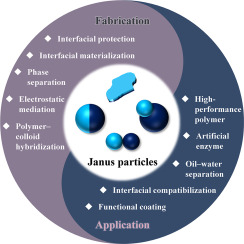
Janus particles with varied compositions thus have distinctly compartmentalized functions and are capable of hybridizing the amphiphilic nature of molecular surfactants or copolymers with the (acoustic, optical, catalytic, magnetic, etc.) functions of solids. Among the various performances, Janus particles are promising in effective stabilization of biphasic interfaces for the precision manipulation and functionalization of interfaces. This mini-review concisely surveys recent advances in synthetic methods for the large-scale fabrication of Janus submicron particles by interfacial protection, interfacial materialization and phase separation, and single-chain nanoparticles by electrostatics-mediated intramolecular crosslinking of polymers in concentrated solutions. Composition, microstructure, and characteristic dimension of the Janus particles are broadly tunable. Janus particles hold great promises in interface engineering relevant applications including functional coatings, compatibilization of multiple polymer blends, and the deep treatment of oil–water emulsions.
https://doi.org/10.1016/j.cjche.2026.06.017
